In the rush to integrate Artificial Intelligence into the modern workplace, the promise is almost always “time saved.” We are told that AI will automate meeting minutes, draft requirements, and identify project gaps, finally giving Project Managers (PMs) and Business Analysts (BAs) their time back.
But as any economist or seasoned project professional will tell you, efficiency is a double-edged sword. To understand the future of project management, we must look to a 19th-century observation: The Jevons Paradox.
What is the Jevons Paradox?
William Stanley Jevons observed that as steam engines became more efficient at burning coal, total coal consumption didn’t drop; it skyrocketed. Because coal was now “cheaper” to use, it became viable for more industries, leading to higher overall demand.
The Bottleneck Shift: Why You Aren’t Working Less
In the context of AI, “cognitive labor” is the new coal. As AI reduces the time required to perform traditional analysis tasks, we are witnessing a fundamental shift in project dynamics.
- The Backlog Avalanche
When AI makes drafting a 20-page Functional Requirement Document (FRD) take seconds instead of days, the “friction” of requesting a new feature disappears. Historically, stakeholders were disciplined by the knowledge that resources were scarce. Now, the cost of asking has hit zero, leading to backlogs that are wider and deeper than ever before. - The Verification Debt
AI is excellent at identifying logical gaps (e.g., a missing data field), but it is currently incapable of identifying business intent gaps. PMs are shifting from “authors” to “editors,” spending their “saved” time endlessly verifying AI- generated output to ensure it hasn’t missed a critical nuance or hallucinated a business rule. - The Communication Explosion
With AI note-takers in every meeting, the volume of documented information has increased exponentially. The challenge is no longer “what was said,” but “what matters.” Sifting through AI summaries to find actionable insights has become a full-time task in itself.
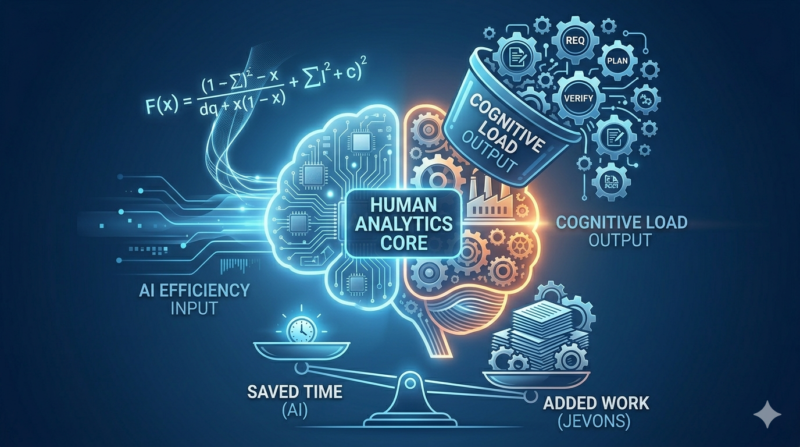
Value = (Human Insight) × (AI Efficiency) − (Verification Time)
The Silver Lining: Moving Up the Value Chain
Despite the threat of “work inflation”, the Jevons Paradox offers a profound benefit for those who adapt. While the volume of work increases, the nature of the work is forced to evolve.
From Clerk to Architect: By offloading the clerical burden of documentation to AI, PMs and BAs are forced to move up the value chain. Our value is no longer in our ability to organise a Jira board, but in our ability to navigate human politics, align conflicting stakeholder visions, and provide the strategic “Why” that AI cannot grasp.
Strategic Risk Mitigation: With AI handling the “obvious” gaps, humans are freed to focus on high-level risks – the kind that require emotional intelligence and long-term foresight. We are moving toward a future where we can build things faster, but our primary job is to ensure we are building the right things.
Conclusion
The Jevons Paradox reminds us that technology rarely simplifies our lives; it complicates them in more productive ways. In an AI-powered world, the most successful project leaders won’t be those who use AI to work less, but those who use it to handle greater complexity with human – centered wisdom.